A few years ago, the phrase “legal engineer” sounded strange to many lawyers. It still does to some.
Lawyers advise. Engineers build. Lawyers interpret ambiguity. Engineers try to reduce ambiguity into systems. Lawyers are trained to reason through facts, law, incentives, risk and institutional context. Engineers are trained to decompose problems, define requirements, test outputs and improve systems over time.
Legal engineering sits precisely at that intersection.
In simple terms, legal engineering is the discipline of turning legal knowledge, legal processes and legal judgment into structured, repeatable, technology-enabled systems. It is not just “using legal tech”. It is not simply prompting a generative AI tool. And it is not the same thing as replacing lawyers with software.
As a financial services lawyer with a computer science background, I see legal engineering less as a fashionable label and more as a practical response to a structural problem: modern law has become too complex, too fast-moving and too operationally embedded to be managed only through memos, email threads and individual expert memory.
That is especially true in regulated sectors such as banking, investment services, payments, crypto-assets, insurance, fintech and market infrastructure. The law is no longer just something businesses ask about. It is something businesses must operationalize.
What is legal engineering?
There is no single universally accepted definition of legal engineering. That is normal for an emerging profession.
My working definition is this:
Legal engineering is the practice of translating legal expertise into structured systems, workflows and tools that allow legal work to be delivered more consistently, efficiently, safely and at scale.
A shorter version would be: Legal engineering is where legal judgment meets system design.
The concept draws from several established disciplines. Computational law has long explored whether legal rules and reasoning can be expressed in machine-processable form. A classic example is the 1986 formalization of the British Nationality Act as a logic program, while more recent work on legal ontologies examines how legal concepts can be structured for automated processing and retrieval. Lawrence Lessig’s Code and Other Laws of Cyberspace is also relevant, not because it is a manual for legal automation, but because it made a deeper point that remains central to legal engineering: technical architecture can regulate behaviour alongside law, markets and social norms.
A legal engineer is not just a “tech-savvy lawyer”. Many lawyers are now becoming better users of technology. That is welcome. But legal engineering goes further.
A tech-savvy lawyer may use AI to summarize a document, draft a clause, compare two versions of an agreement, or produce a first draft of a memo. A legal engineer asks how the whole process should be designed.
For example, take a regulatory change management process in financial services. A traditional approach may involve newsletters, alerts, internal emails, ad hoc memos and periodic meetings. A more engineered approach might include elements such as:
- automated retrieval of new Level 1 and Level 2 measures;
- classification by topic, jurisdiction, business line and implementation deadline;
- mapping to internal policies, products and affected functions;
That is not science fiction. Parts of this can already be done with relatively ordinary tools. In one of my own earlier technical explorations, for example, I looked at automating the retrieval and categorization of EU financial services Level 1 and Level 2 acts using Python. That kind of exercise is not about showing that lawyers should become software developers (or vibe coders). It shows something more important: legal information can often be structured, classified and operationalized much better than our current workflows suggest.
The core problem: law is not naturally deterministic
The reason legal engineering is difficult is also the reason it is valuable. Law is not code!
Legal rules are written in language. Language is ambiguous. Legal meaning depends on context, purpose, hierarchy of norms, facts, evidence, institutional practice, regulatory expectations, market standards and sometimes judicial discretion.
In financial services law, this is obvious. Whether an activity is regulated may depend not only on the wording of legislation, but also on guidance, exemptions, territorial scope, the structure of the product, the identity of the client, the role of intermediaries and the commercial reality of the arrangement.
A legal engineer must understand that some legal work can be translated into rules, but not all legal judgment can be reduced to rules.
This is why one of the most important skills in legal engineering is decomposition. A legal engineer must distinguish between at least five things:
- Legal judgment is what requires a qualified lawyer, regulator, court or accountable human decision-maker. This includes interpretation, strategy, balancing risk, assessing uncertainty and deciding what is appropriate in context.
- Legal process is the sequence of steps through which work moves: intake, triage, review, negotiation, approval, filing, reporting, evidence collection and matter management.
- Legal knowledge includes statutes, regulations, guidance, policies, clauses, risk rules, standards, precedents, obligations and internal playbooks.
- Legal artefacts are the outputs of legal work: contracts, notices, advice memos, board papers, compliance reports, pleadings, policies, audit logs and regulatory filings.
- Legal data includes matter metadata, contract metadata, obligation registers, risk classifications, consent records, model outputs, vendor attestations, review decisions and evidence trails.
Once those categories are separated, legal work becomes easier to design.
What does a legal engineer actually do?
The practical work of a legal engineer varies by organization. In a law firm, the role may focus on scalable legal service delivery, client-facing tools, AI-assisted workflows and knowledge products. In an in-house legal team, it may focus on legal operations, compliance automation, contract processes and internal self-service. In a regulated financial institution, it may involve AI governance, regulatory mapping, controls, vendor oversight and auditability.
Typical legal engineering work includes:
- designing legal intake and triage systems;
- building contract automation workflows;
- creating clause libraries and negotiation playbooks;
- turning regulatory requirements into compliance controls;
- mapping legal obligations to business processes;
- developing legal knowledge bases;
- building AI-assisted review systems;
- testing legal AI outputs;
- designing human-in-the-loop approval processes;
- creating audit trails for legal decisions;
- structuring matter and contract metadata;
- training AI models.
Traditional legal advice is usually delivered to one client, on one matter, at one point in time. Legal engineering asks whether parts of that expertise can be captured in a reusable structure that improves many future matters.
The three dimensions of legal engineering
I find it useful to think about legal engineering in three dimensions: intellectual, operational and human.
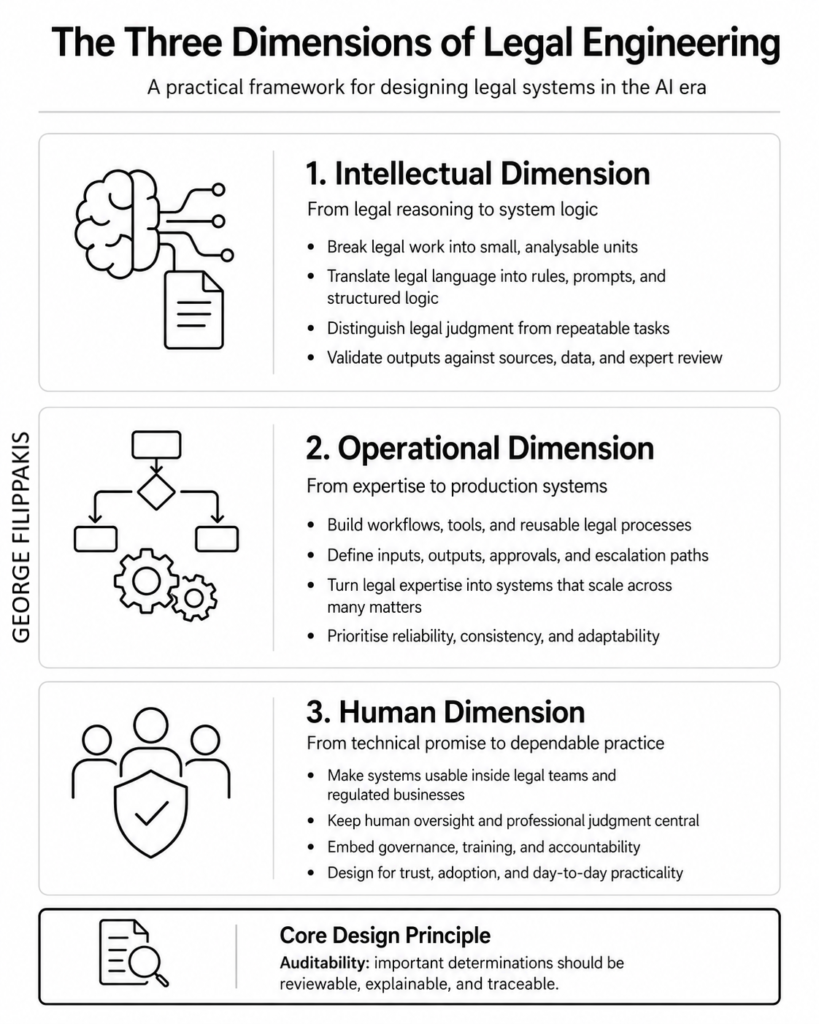
1. The intellectual dimension: translating legal reasoning into structured analysis
Legal engineers break down complex legal workflows into smaller units of analysis. Some of those units can be expressed as rules. Some can be expressed as questions. Some can be expressed as data extraction tasks. Some may be suitable for AI-assisted classification. Others require human review.
Large language models can be useful here because they act as a translation layer between legal language and computational workflows. They can classify, summarise, compare, extract and draft in ways that older rule-based systems struggled to do.
But they are not magic. They are probabilistic systems. They can produce plausible wrong answers. They can miss context. They can overstate certainty. They can cite sources incorrectly if not properly constrained.
The legal engineer’s task is therefore not to “ask AI legal questions”. It is to design a structured process in which AI performs bounded tasks, on appropriate materials, with clear evaluation criteria, escalation paths and human oversight.
2. The operational dimension: building reusable legal systems
The operational dimension is about construction.
Legal engineers build tools, workflows and repeatable processes. This makes the role closer to software engineering than traditional legal advisory work.
A software engineer does not usually solve the same problem manually every time. They build something that can solve a class of problems repeatedly. Legal engineering applies a similar mindset to legal services.
Consider client onboarding for a regulated financial institution. The legal and compliance questions may involve AML/KYC, sanctions, investor classification, cross-border restrictions, product governance, suitability, disclosures, data protection and record keeping.
A purely manual process may work for a small volume of clients. But at scale, it becomes inconsistent, expensive and difficult to audit.
A legal engineering approach would aim to convert the process into a structured workflow. The system would collect the right information, apply the relevant logic, flag exceptions, route approvals, capture evidence and preserve the final rationale.
3. The human dimension: making technology usable in legal practice
The human dimension is often underestimated.
Lawyers do not adopt systems simply because they are technically impressive. They adopt systems when those systems fit the reality of legal work.
Legal work is high-pressure, detail-sensitive and reputationally risky. A tool that is slightly wrong, poorly explained or badly integrated into existing workflows will not survive.
The legal engineer must therefore smooth the interface between technology and practice.
The best legal systems are not necessarily the most complex. They are the ones lawyers, clients, compliance officers and business teams can actually trust and use.
Legal engineering in financial services
Financial services is one of the areas where legal engineering is likely to become particularly important.
The reason is simple: financial services law is dense, dynamic and operational.
Rules are not just interpreted. They must be implemented in policies, systems, controls, disclosures, regulatory filings, reporting processes, governance arrangements, client journeys and product architecture.
A new regulatory requirement may affect legal, compliance, risk, operations, technology, finance, product, sales and senior management. The work is cross-functional by nature.
In this environment, legal engineering can help with tasks such as:
- regulatory change management;
- licensing analysis;
- cross-border services mapping;
- outsourcing and third-party risk workflows;
- operational resilience controls;
- crypto-asset regulatory perimeter analysis;
- policy management;
- and AI governance for regulated entities.
The future financial services lawyer will not only explain the law. Increasingly, they will help design the systems by which the institution complies with the law.
Auditability should be a core design principle
If I had to identify one principle that separates serious legal engineering from superficial legal tech enthusiasm, it would be auditability.
In law, it is rarely enough to get the right answer. You must often be able to show how the answer was reached.
This matters in litigation. It matters in regulatory supervision. It matters in internal governance. It matters in professional negligence. It matters in financial services compliance. And it matters even more when AI is involved.
A proper legal engineering system should be able to show:
- what materials were used;
- which version of the law or policy applied;
- what assumptions were made;
- what the system extracted or classified;
- what the AI suggested;
- who reviewed it;
- what changes were made;
- who approved the final output;
- what exceptions were escalated;
- and what evidence was retained.
This is one reason I do not see legal engineering as a threat to legal oversight. Properly done, it strengthens oversight.
Many traditional legal decisions are made through email chains, calls, marked-up documents and informal memory. That can work, but it often leaves a weak record.
A well-designed legal engineering workflow can create a clearer audit trail than the traditional process it replaces.
What skills does a legal engineer need?
A legal engineer does not need to be an expert in everything. But the role does require range.
The core skill set includes the following.
Legal experience
Without real legal understanding, the role collapses into generic process consulting. A legal engineer must understand legal reasoning, sources of law, hierarchy of norms, professional obligations, privilege, confidentiality and the practical consequences of legal error.
In regulated industries, domain expertise matters even more. A person designing a financial services compliance workflow must understand the regulatory architecture, not merely the software.
Technical literacy
A legal engineer does not always need to write production code. But they should understand how systems work.
That means familiarity with databases, APIs, automation platforms, document systems, AI models, retrieval systems, access controls, versioning, testing and basic software architecture.
Even a modest ability to work with Python, structured data or no-code tools can be powerful. It changes how a lawyer thinks. You begin to see legal work not only as text, but as information flows, decision points and reusable components.
Process design
Legal engineering requires the ability to map current workflows, identify bottlenecks, define target states and design better processes.
This is where legal operations and project management become important. CLOC’s work on legal operations reflects the broader movement toward treating legal teams as strategic, operationally mature business functions rather than purely reactive advisory units.
Data thinking
Modern legal work produces and depends on data.
Contracts contain metadata. Matters contain status information. Regulatory obligations can be mapped. Policies can be tagged. AI outputs can be evaluated. Risk decisions can be logged.
Legal engineers need to understand data quality, taxonomies, classification, retention, access rights and audit trails.
AI governance
In the AI era, legal engineers need at least a working understanding of model limitations, hallucination risk, prompt injection, retrieval-augmented generation, evaluation datasets, human review, monitoring and vendor risk.
This is not optional in regulated environments. It is part of responsible system design.
Communication
Finally, legal engineers must be able to explain complex systems in plain language.
A system that only its designer understands is not a legal engineering success. It is a governance risk.
How to become a legal engineer
There is no single route into legal engineering.
Some legal engineers will come from legal practice. Others will come from legal operations, compliance, computer science, product management, data, consulting or legal technology.
For lawyers, the best path is not necessarily to become a full-time developer. It is to become technically literate enough to design better legal systems.
A practical learning path might include:
- learning basic workflow mapping;
- understanding legal operations;
- working with document automation;
- learning the basics of databases and APIs;
- experimenting with Python or another accessible programming language;
- studying AI governance frameworks;
- learning how retrieval-augmented generation works;
- understanding prompt design and model evaluation;
- building small legal tools;
- and working closely with technologists.
The best way to learn is to take a recurring legal problem and try to systematize it.
Ask what the legal process is trying to achieve, where it fails, what information it needs, where judgment is required and what a better workflow would look like.
Conclusion: why legal engineering matters for the future of law
Legal engineering is becoming important because law itself is becoming more operational, more data-driven and more technologically mediated.
AI has accelerated the trend, but it did not create it.
The underlying need is older and deeper: legal teams must deliver better, faster, more consistent and more auditable legal support in environments that are increasingly complex.
Legal engineering offers a practical way forward.
It does not ask lawyers to abandon judgment. It asks them to design better systems around judgment.
It does not reduce law to code. It recognises that some parts of legal work can be structured, some can be automated, some can be augmented and some must remain firmly human.
For lawyers with technical literacy, commercial awareness and domain expertise, this is a significant opportunity.
For legal teams, it is a path toward more scalable and resilient service delivery.
For regulated businesses, it is a way to connect legal interpretation with real operational compliance.
And for the profession as a whole, legal engineering may become one of the main ways legal expertise remains relevant, trusted and useful in the AI era.
The future of law will not be written only in contracts, statutes and legal opinions.
It will also be built into systems.
The question is whether lawyers will help design them.
Leave a Reply