The legal profession has always rewarded deep subject matter expertise. What is changing now is the ability to convert that expertise directly into working software, without requiring years of traditional engineering experience.
That shift is being accelerated by what many now call “vibe coding“: building software through natural-language collaboration with large language models (LLMs).
For legal, regulatory and compliance professionals, this is far more than a novelty. It is becoming a genuine productivity advantage.
Recently, I built a Python-based exporter designed to collect, classify and export Level 1 and Level 2 EU financial services legislation from Eur-Lex. The tool was developed on VS Code primarily through natural-language prompting and iterative refinement with various LLMs. In approximately two hours!
The result was not a polished enterprise platform. But it was functional, highly customized, and immediately useful.
More importantly, it demonstrated something increasingly difficult to ignore: Legal expertise can now be translated directly into executable code.
That changes the economics of legal operations, compliance tooling and regulatory intelligence.
From Legal Logic to Executable Code
The exporter prototype was designed to automate a type of legal mapping exercise familiar to many financial services lawyers and compliance teams.
Its objective, and the prompting that supported its implementation, was straightforward:
- identify Level 1 EU financial services legislation,
- identify related Level 2 measures,
- classify acts by regulatory domain,
- and export structured datasets for downstream use.
The script fetched legislation from EUR-Lex by querying the EU Publications Office’s CELLAR repository, applied filtering and classification logic, and generated structured outputs that could be used internally by legal and compliance teams.
The categories included areas such as:
- banking and prudential regulation,
- payments,
- AML/CFT,
- MiFID and capital markets,
- funds and asset management,
- ESG and sustainable finance,
- crypto-assets,
- operational resilience,
- insurance and pensions.
Traditionally, developing a bespoke regulatory tool of this nature would require coordination across multiple functions: legal subject matter experts, business analysts, software engineers and project stakeholders. Even relatively narrow internal tools often involve extensive specification meetings, translation of legal requirements into technical documentation, and multiple development cycles before a usable prototype emerges.
Modern LLMs are beginning to compress much of that process dramatically. Legal and regulatory professionals can increasingly translate legal logic directly into executable workflows using natural-language instructions. In practice, this allows the lawyer or compliance professional to simultaneously act as subject matter expert, product designer, logic architect and functional tester, while the LLM effectively becomes the implementation layer. The result is a much faster and more iterative approach to developing highly customized legal and compliance tooling.
Why This Matters for Regulatory and Compliance Teams
Many areas of legal and regulatory practice involve navigating large volumes of legislation, regulatory relationships and structured legal information.
Tasks such as legislative mapping, regulatory inventories, cross-jurisdiction analysis or obligation tracking often require significant time and manual effort, particularly in highly regulated sectors such as financial services. This creates a strong opportunity for lightweight internal tooling that can assist legal and compliance professionals in organizing, processing and analyzing regulatory data more efficiently.
What makes vibe coding particularly powerful is that legal professionals no longer need to be traditional software engineers to build useful tools. With a basic engineering mindset and the ability to communicate requirements clearly, lawyers and compliance professionals can increasingly use natural-language instructions to generate scripts, automate workflows, process legal datasets and rapidly prototype bespoke solutions tailored to specific regulatory use cases.
I believe the productivity gains can be substantial, especially for teams operating in complex and fast-moving regulatory environments.
The EU Financial Services Exporter: A Practical Example
The exporter prototype illustrates this shift well.
The tool was designed to fetch Level 1 and Level 2 EU legislation, identify financial services legislation, classify legislation into regulatory categories and export structured results. The EU Financial Services Exporter is fully open source and free to use or edit.
This tool could allow legal and compliance professionals to automate portions of regulatory mapping exercises.
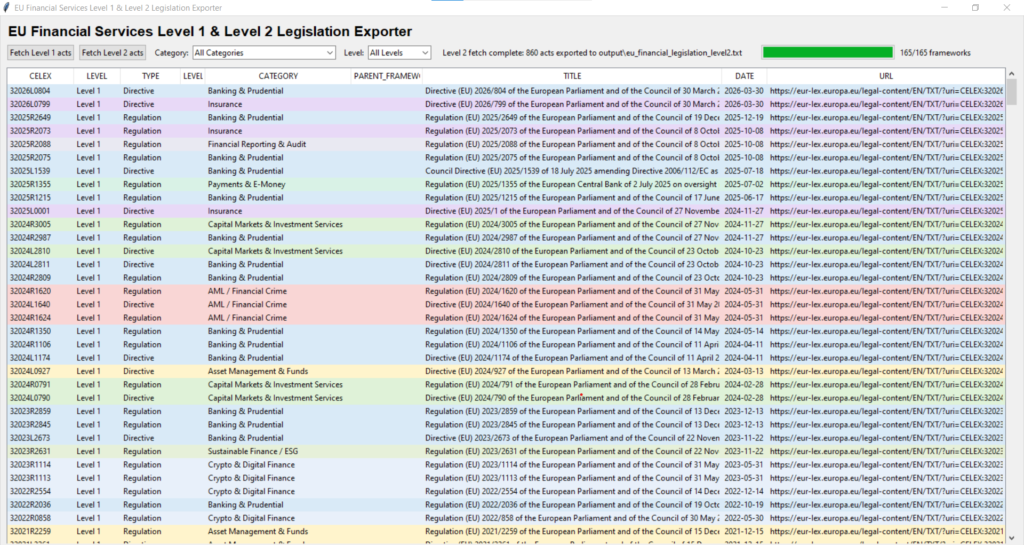
For example, this tool can be used (or expanded) to:
- identify all EU payments legislation,
- build an AML/CFT legislative inventory,
- create a MiFID II regulatory dataset,
- map DORA-related legislation,
- track sustainable finance frameworks.
These are exercises that frequently consume significant legal and operational resources. Even partial automation can create meaningful efficiency gains.
And importantly, the prototype was highly tailored to a specific legal use case from the outset.
That level of customization is difficult to achieve with generic off-the-shelf legal technology products.
Is Vibe-Coded Legal Tech Perfect? Absolutely Not.
The prototype also exposed the limitations of current LLM-assisted development.
The filtering engine relied heavily on keyword matching. As a result some non-financial legislation was incorrectly captured, while some relevant legislation was missed entirely.
For example:
- certain agricultural legislation was incorrectly classified as financial services legislation,
- while some important niche financial-services frameworks were omitted.
This is not surprising. Legal and regulatory classification is inherently difficult because legislative language is context-sensitive and highly nuanced.
A rule-based keyword approach can only go so far. This is precisely why an engineering mindset matters.
Legal professionals using AI-assisted development need to think like system designers: identify edge cases, test assumptions, refine logic, improve taxonomies and iterate continuously.
In other words, the legal expertise remains essential.
The LLM accelerates implementation, but subject matter experts still provide the most valuable elements: judgment, validation and domain intelligence.
The Emerging Skillset: Legal + Engineering Literacy
Perhaps the most effective legal and compliance professionals in the coming years are unlikely to be those who can write complex software from scratch.
Instead, they will be professionals who can think structurally, understand systems, decompose legal problems logically and collaborate effectively with AI tools.
A lawyer with regulatory experitse, process awareness and basic engineering literacy can now produce prototypes that previously required dedicated technical teams.
This new reality does not necessarily eliminate the need for professional software engineers. Enterprise-grade systems may still require:
- robust architecture,
- security,
- scalability,
- testing,
- governance,
- and production engineering standards.
But many internal legal and compliance tools do not initially require enterprise-level complexity.
Often, teams simply need a targeted workflow utility, a structured data extractor, a classification engine, or an automation layer for repetitive analysis.
Vibe coding dramatically lowers the barrier to creating those tools.
Why Bespoke Legal Tech Is Becoming More Accessible
One of the biggest limitations of traditional legal technology has always been customization.
Legal teams often operate in highly specialized regulatory environments, niche jurisdictions, or institution-specific compliance frameworks.
Commercial legal-tech platforms frequently struggle to address these highly tailored needs.
With LLM-assisted development, legal professionals can now rapidly prototype highly customized internal tools, specific to their:
- organization,
- jurisdiction,
- regulatory perimeter,
- operational model.
This creates a new category of lightweight, domain-specific legal tooling.
Instead of waiting months for development cycles or procurement approvals, professionals can increasingly prototype, test, refine and deploy internal utilities rapidly.
Final Thoughts
The EU financial services exporter I vibe-coded in a couple of hours is not perfect. It contains classification errors. Its filtering logic needs refinement. Its taxonomy can be improved.
But that is not the point.
The important point is that a lawyer with a CS background, using simply natural-language interaction with an LLM, was able to produce a genuinely useful regulatory intelligence prototype in roughly two hours.
That would have been extraordinarily difficult only a few years ago.
The gap between legal expertise and software creation may be narrowing rapidly.
The professionals who learn to operate effectively at that intersection will likely have a meaningful advantage in the future of legal, regulatory and compliance work.
Leave a Reply